
Storage for Medical Records

Medical Records Storage Systems for Healthcare File Management

SAS provides medical records storage systems for healthcare records rooms, clinics, hospitals, laboratories, rehabilitation facilities and centralized healthcare archives.

Medical filing cabinets, archive cabinets and high-density mobile shelving can be combined according to record status, retrieval frequency, confidentiality, stored-item format and available archive-room capacity.

For hospital-specific workflow, departmental transfers and hospital archive zoning, review our hospital medical records storage guide .
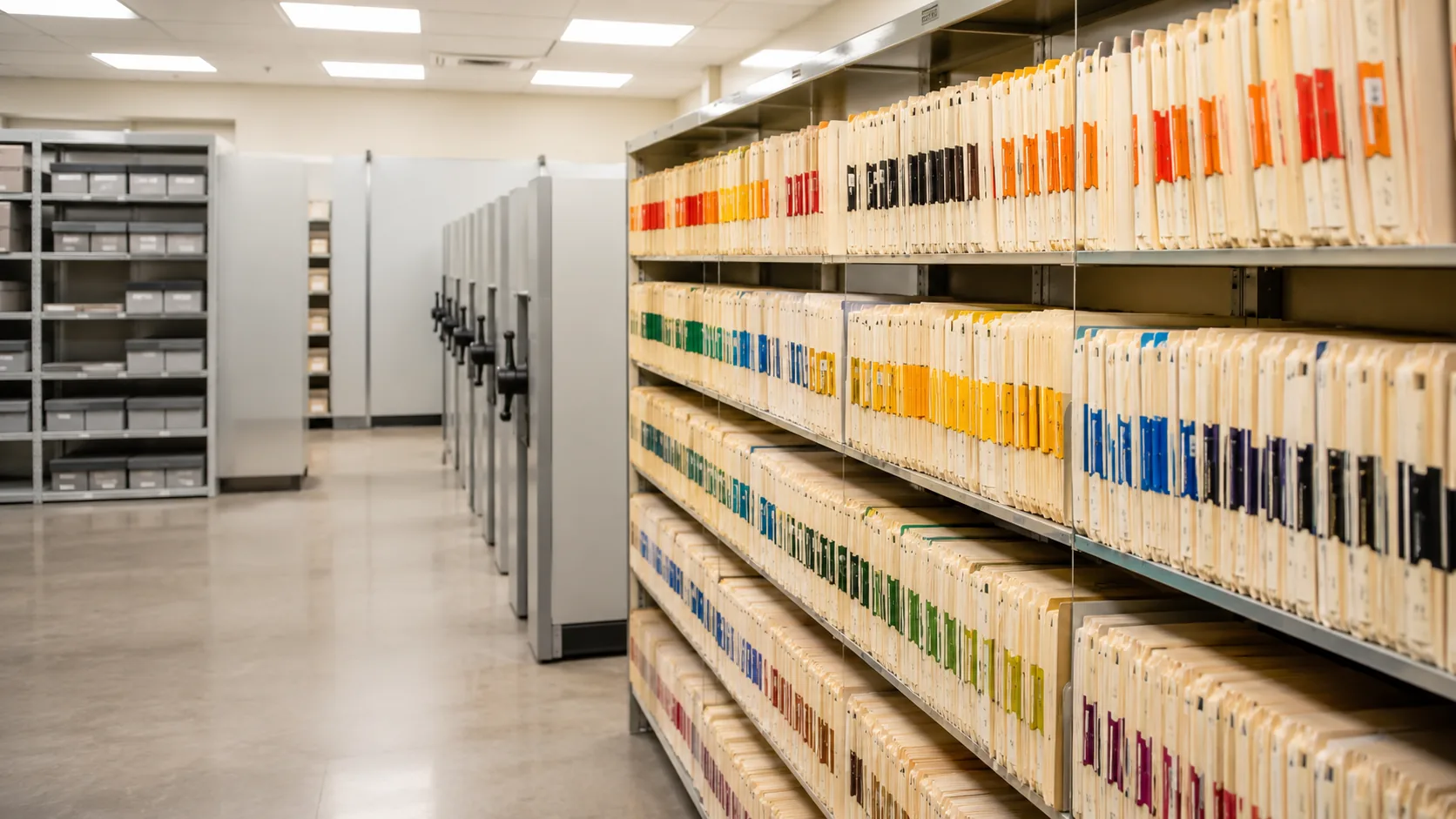
Medical Records Storage Systems Medical File Storage Medical Filing Systems High-Density Archive Storage
medical records storage systems and healthcare file storage solutions
Centralized Medical Records Storage
Manual, electric and smart mobile shelving can be configured according to archive volume, retrieval frequency and approved control requirements.
Record Classification
Active, Semi-Active and Long-Term
Separate files by use frequency, retention status and department ownership.
Controlled Access
Locks and Project-Based Permissions
Select physical locks or approved electronic access functions according to the project.
Storage Systems
Cabinets and Mobile Shelving
Combine filing cabinets, archive cabinets and mobile shelving for different record groups.
Archive Planning
Capacity, Workflow and Safety
Review room dimensions, file growth, retrieval routes and structural conditions.
Healthcare Record Lifecycle

How Medical Records Storage Systems Support Active, Semi-Active and Long-Term Files

An effective medical filing system classifies documents by retrieval frequency, department ownership, confidentiality, retention status and physical format before the final cabinets or shelving rows are selected.

01
Frequent Retrieval

Active Medical Records

Current inpatient files, outpatient records, treatment documents and frequently used clinical information.

Recommended: lockable medical file cabinets close to records staff.
02
Periodic Review

Semi-Active Records

Recently completed treatment records and departmental healthcare archives that still require periodic retrieval.

Recommended: enclosed archive cabinets or accessible mobile shelving.
03
Extended Retention

Long-Term Medical Archives

Historical patient files, research archives, surgical records and other retained institutional documents.

Recommended: centralized high-density mobile shelving systems.
Common Medical Archive Challenges

Balance Retrieval Speed, Confidentiality and Long-Term Capacity

Medical records storage systems need to handle high file volumes, mixed formats, restricted information and demanding records-room management conditions.

01

Growing Record Volume

New patient files and healthcare documents can spread across departments and unsuitable storage areas.

02

Mixed Active and Inactive Files

Older records can consume valuable working space and slow daily file retrieval.

03

Confidential Information

Sensitive records may require locks, restricted rooms and clearly defined access responsibility.

04

Limited Archive-Room Area

Permanent aisles in fixed shelving reduce usable storage capacity.

05

Different Record Formats

Folders, binders, boxes and other stored formats may require different shelf dimensions.

06

Cleaning and Preservation

Dust, ventilation, humidity and water-leak risks can affect long-term records storage.

Medical Filing Systems

Medical Records Storage Systems Using Cabinets and Mobile Shelving

Medical records storage rarely depends on one cabinet type. Medical file cabinets, archive cabinets and mobile shelving can be combined according to retrieval frequency, security requirements, archive volume and available room space.

Daily Patient File Storage

Medical Records File Cabinets

Lockable vertical, lateral, drawer and hanging-file cabinets for frequently retrieved folders and office-level healthcare records.

Best fit: records offices, outpatient areas and active-file working zones.
View filing cabinets →
Enclosed Document Protection

Medical Archive Storage Cabinets

Adjustable shelves and lockable doors for semi-active patient records, laboratory documents and confidential healthcare archives.

Best fit: departmental archives and controlled document groups.
View archive cabinets →
Simple High Density

Manual Mobile Shelving

Handwheel-operated shelving reduces permanent aisle space without an electrical drive system.

Suitable for moderate retrieval frequency.
View system →
Motorized Operation

Electric Mobile Shelving

Motorized movement and project-confirmed control and safety functions can support frequently used healthcare archives.

Suitable for medium and large archive rooms.
View system →
Controlled Management

Smart Medical Records Storage

Touchscreen operation, visible system status and project-confirmed user-permission or integration functions can be considered where required.

Suitable for controlled centralized healthcare archives.
View system →
Medical Filing System Overview

One Medical Records Storage System Can Include Several Filing Methods

Healthcare records rooms can assign different products to active files, protected departmental records and long-term centralized archives.

Medical File Cabinets For active patient records and frequently retrieved documents.
Archive Cabinets For protected semi-active records and confidential file groups.
Mobile Filing Systems For centralized archives requiring greater storage density.
Department-Based Classification

Assign Record Ownership Before Assigning Shelf Space

Clear classification can reduce misplaced files, uncontrolled access, duplicate storage and unclear disposal responsibility.

Classification Fields

Department or archive owner Identify who controls and uses the records.
Record category Separate clinical, administrative and technical documents.
Retention status Distinguish active, recent, long-term and review-ready files.
Confidentiality level Assign cabinet, room or project-specific user restrictions.
Medical Records Department
Patient files, admission documents, discharge records and related healthcare records. Recommended: patient file cabinets and mobile shelving.
Outpatient Departments
Consultation files, follow-up records and frequently retrieved documents. Recommended: active filing cabinets near records staff.
Medical Laboratories
Test reports, quality documents, calibration files and equipment records. Recommended: adjustable archive cabinets.
HR, Finance and Quality
Staff qualifications, billing, audit and training records. Recommended: lockable cabinets and restricted archive zones.
Capacity Planning

Medical Records Storage Systems Should Be Planned Around Real File Growth

Folder quantity, average file thickness, annual growth, retention period, archive-box dimensions and aisle configuration all affect the final capacity.

Current files + annual growth + retention requirement + reserve capacity = preliminary storage demand
01

Measure Current Records

Count folders, archive boxes, binders and current linear shelf length.

02

Classify Record Groups

Divide files by department, use frequency, confidentiality and retention status.

03

Estimate Future Growth

Include expected records growth, departmental changes and realistic reserve capacity.

04

Review Floor Loading

High-density mobile shelving concentrates stored load and may require structural review.

Medical Records Room Layout

Coordinate Receiving, Active Files, Mobile Rows and Confidential Storage

The archive room should support verification, registration, classification, retrieval, return, inspection and cleaning.

Typical Functional Sequence

The final arrangement depends on room dimensions, doors, columns, archive volume and workflow.

Receiving Registration Active Files Mobile Shelving Restricted Storage
Zone 01

Receiving and Sorting

Incoming files are verified, registered, labeled and classified before storage.

Zone 02

Active Patient Files

Frequently used records remain near authorized records staff.

Zone 03

Central Mobile Shelving

Older files use higher-density storage with clear row and shelf identification.

Zone 04

Confidential Storage

Sensitive records use restricted cabinets or controlled archive zones where required.

Mobile Shelving Comparison

Manual, Electric or Smart Shelving for Medical Records?

Medical records storage systems can use different mobile-shelving operation levels according to project scale, retrieval frequency and management requirements.

Comparison Item
Manual
Electric
Smart
Operation
Handwheel mechanical drive
Motorized movement
Motorized coordinated control
Access control
Mechanical locks
Project-specific electrical controls
Configured user-permission options where specified
Record identification
Manual labels and shelf codes
Manual labels or project-specific support
Optional project-specific identification or integration functions
Typical use
Small and medium archives
Medium and large archives
Controlled centralized archives
Confidentiality and Access Control

Protect Patient Information by Cabinet, Zone and Access Responsibility

Mechanical Locks Drawer locks, cabinet locks, row locks and controlled key systems can provide straightforward physical control.
Restricted Zones Sensitive record groups can be separated by cabinet bank, archive room or approved storage zone.
Electronic Permission Options Project-confirmed password, card or other approved permission methods may be considered with suitable smart systems.
Environmental Considerations

Plan the Archive Room for Inspection and Preservation

Dust Control Enclosed cabinets and accessible shelving rows can support routine cleaning.
Ventilation Shelving layout should not unnecessarily block room ventilation or air-conditioning equipment.
Water-Leak Risk Known leak-risk areas should be reviewed during archive-room planning.
Important Project Boundary
SAS provides physical storage systems and archive-room planning. Medical-record retention periods, patient-privacy requirements, disposal procedures and healthcare compliance should be confirmed by the healthcare facility according to applicable local regulations and internal policies. For projects in the United States, refer to the U.S. Department of Health and Human Services HIPAA Security Rule information .
Typical Technical Reference

Preliminary Ranges for Medical Records Storage Systems

Final dimensions, load capacity, drive method, controls and safety functions should be confirmed according to the selected products, room conditions and stored record formats.

Main material
Cold-rolled steel with powder-coated surface
Storage products
Steel filing cabinets, archive cabinets and mobile shelving systems
Mobile system type
Manual, electric or smart
Typical shelving height
Approximately 1,800–2,600 mm depending on selected system and room conditions
Typical bay width
Approximately 800–1,200 mm depending on selected shelving configuration
Shelf depth
Approximately 250–600 mm according to folders, archive boxes, binders or other stored formats
Shelf levels
Commonly 4–8 adjustable levels depending on record dimensions and shelving design
Shelf loading
Approximately 40–120 kg uniformly distributed load depending on shelf structure and span
Access options
Mechanical locks or project-specific electrical / smart permission functions according to selected system
Safety options
Project-specific braking, emergency-stop, obstacle-detection, anti-tilt and warning functions
Installation
Project-based installation and testing scope according to destination and agreed responsibilities
These values are general planning references only. Final specifications should be confirmed after reviewing the archive-room dimensions, record quantity, file format, floor conditions and required control functions.
Project Workflow

From Room Drawings to Installation and Handover

SAS develops medical records storage systems through a project-based process beginning with archive-room dimensions, record classification and capacity calculations, followed by layout confirmation, production, installation and testing.

01

Requirement Collection

Review room dimensions, record categories, quantity, growth and access requirements.

02

Capacity Calculation

Convert file quantities into shelf length, cabinet quantities and reserve capacity.

03

Preliminary Layout

Plan active files, mobile rows, restricted zones, work areas and future expansion.

04

Technical Confirmation

Confirm dimensions, loading, locks, controls, safety functions, color and installation scope.

05

Production and Inspection

Manufacture, inspect, identify and pack products according to the approved project configuration.

06

Installation and Handover

Verify alignment, locking, movement and project-confirmed control or safety functions before handover.

Quotation Checklist

Information Needed for a Medical Records Storage Quotation

When the final layout is not confirmed, send the room plan and approximate record quantity first. SAS can use these details for preliminary capacity and product planning.

Healthcare facility type
Archive-room dimensions or CAD / floor plan
Ceiling height, columns and doors
Current record quantity or linear shelf length
Folder, binder or archive-box dimensions
Expected annual growth
Retrieval frequency and access requirements
Preferred cabinet or mobile shelving type
Frequently Asked Questions

Medical Records Storage Systems FAQ

What is a medical records storage system?
A medical records storage system is a planned combination of medical file cabinets, archive cabinets, mobile shelving, labels, access controls and room-layout rules used to organize active, semi-active and long-term healthcare records.
What is the difference between medical file storage and medical archive storage?
Medical file storage usually supports active or frequently retrieved records. Medical archive storage focuses on semi-active and long-term records requiring organized capacity and controlled retrieval.
Which medical filing system is suitable for active records?
Active records are commonly stored in lockable filing cabinets or medical file cabinets near records staff. The final choice depends on file format, retrieval frequency, room space and access requirements.
Can medical records file cabinets be locked?
Yes. Individual cabinet locks, drawer locks, controlled key systems and project-specific access options can be considered according to the selected storage product.
How can medical records storage systems increase archive capacity?
Active and inactive files can be separated, unnecessary permanent aisles can be reduced, and high-density mobile shelving can be used for suitable long-term records where room layout and floor conditions allow it.
Should all medical records be stored in mobile shelving?
Not always. Frequently retrieved records may be more practical in filing cabinets, while larger inactive archives may be better suited to mobile shelving. Mixed systems are often more practical.
What is the best storage for medical records?
The best storage depends on retrieval frequency, file format, confidentiality, retention requirements and available room space. Active records may use filing cabinets, while semi-active and long-term archives may use archive cabinets or mobile shelving.
Are medical records file cabinets suitable for long-term archives?
Medical records file cabinets can support smaller long-term collections or restricted record groups. For larger centralized archives, mobile shelving may provide greater storage density when the room, floor load and access workflow are suitable.
Medical Records Storage Project

Planning Secure Storage for Medical Records?

Send your archive-room dimensions, floor plan, file quantity, record format, department structure and access requirements. SAS can help develop suitable medical records storage systems, including capacity planning, product combinations and a preliminary archive-room layout.

Request a Medical Records Storage Plan