Government Archive Storage Solutions for Secure Records Management
SAS provides government archive storage solutions for public agencies, municipal departments, land and planning offices, tax authorities, education bureaus and centralized government record centers.
Manual, electric and smart mobile shelving can be combined with archive cabinets and filing cabinets according to capacity, security, access frequency and long-term public-record management requirements.
The resulting archive-room plan supports public records storage, secure retrieval, high-density document storage and future capacity planning without forcing every department into the same storage system.
Long-retention public records need organized retrieval and realistic growth planning
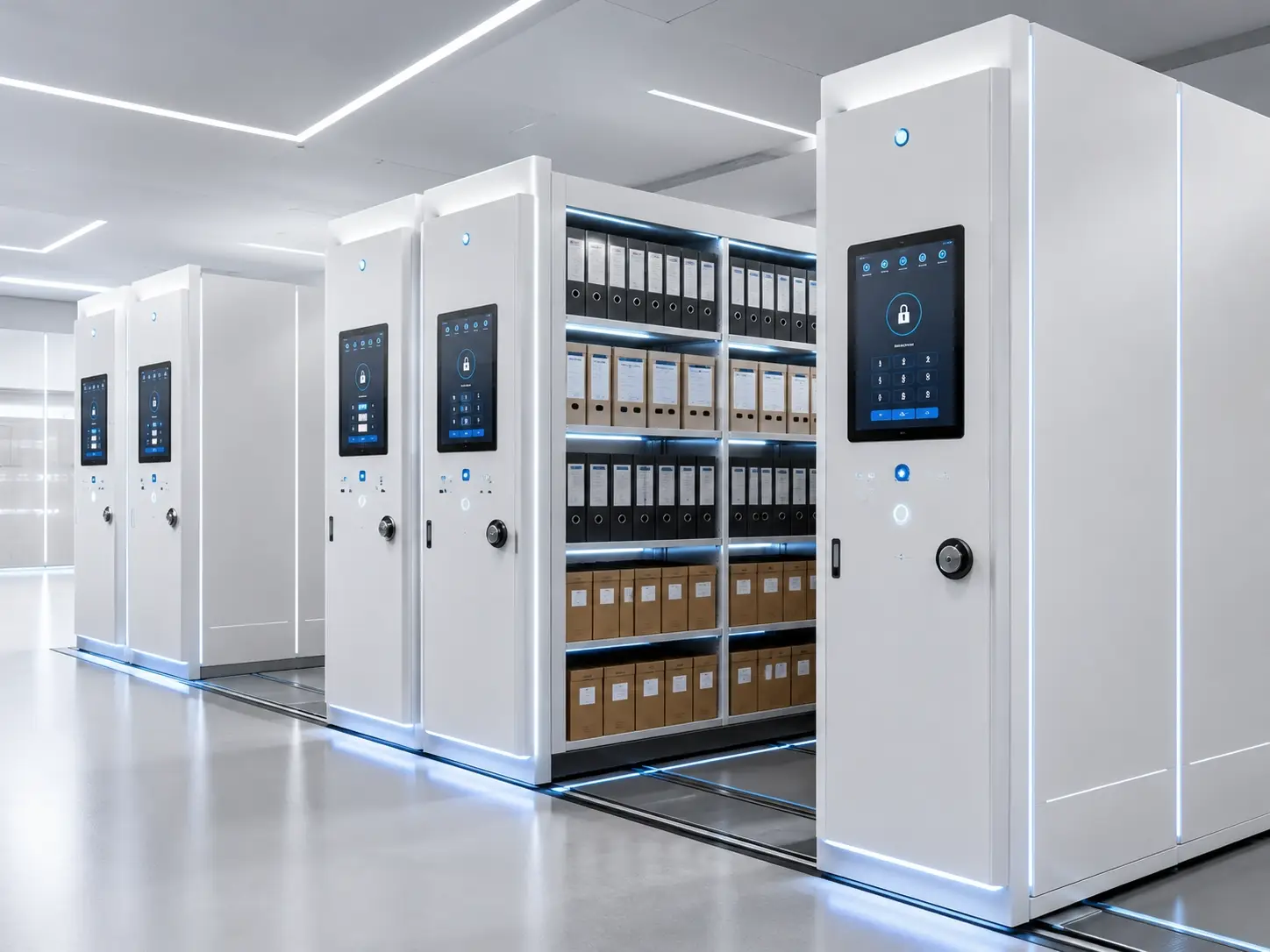
Government records may remain in storage for many years while still requiring reliable retrieval. A records-room system should help protect documents from unnecessary handling and unauthorized access without making ordinary staff workflows unnecessarily complicated.
Frequently used departmental files may remain in filing cabinets or accessible archive cabinets, while larger volumes of inactive records can be transferred to mobile shelving for higher storage density and centralized organization.
A public archive project must solve more than a shortage of shelves
Public agencies may need different storage arrangements according to available space, record formats, security, retention time, access frequency and future archive growth.
Limited Room Capacity
Records continue to accumulate while archive rooms remain unchanged. Mobile shelving can reduce permanent aisle requirements.
Mixed Record Formats
Archive boxes, folders, registers, maps and drawings may require different shelf depths and internal arrangements.
Security and Access
Confidential records may require cabinet locks, restricted rooms or project-confirmed permission-controlled systems.
Long Retention Periods
Shelving structure, coating, labels and load capacity should support organized long-term indoor storage.
Frequent Retrieval
High-use records should remain closer to entrances, sorting areas or staff work zones.
Future Archive Growth
The initial layout should reserve realistic capacity or allow phased expansion where the room and project permit it.
Use different systems for active, protected and long-term records
A complete public-sector archive often combines mobile shelving, archive cabinets and filing cabinets instead of relying on one product for every record category.
Manual Mobile Shelving
Handwheel-driven movement provides high-density archive storage without an electrical drive system, making it suitable where moderate access frequency and straightforward operation are preferred.
View Manual Mobile Shelving →Electric Mobile Shelving
Motorized row movement and project-configured safety functions can support larger or more frequently accessed government archive rooms.
View Electric Mobile Shelving →Smart Mobile Shelving
Touchscreen operation, visible system status, configured user permissions and project-specific management functions can support controlled public-sector archives.
View Smart Mobile Shelving →Archive Storage Cabinets
Lockable steel cabinets support active departmental records, protected files, bound registers and smaller document groups that benefit from enclosed storage.
View Archive Storage Cabinet →Steel Filing Cabinets
Drawer systems support personnel, finance, procurement and other active documents that require frequent categorized retrieval.
View Steel Filing Cabinet →Manual, electric or smart mobile shelving?
The correct option depends on room size, stored volume, access frequency, management requirements, project budget and maintenance expectations.
Convert public records and future growth into shelf length
Counting boxes alone may be misleading because box dimensions and folder thickness vary. Linear shelf length, record categories and annual growth provide a stronger basis for preliminary archive planning.
Measure Current Records
Use archive boxes, binders, files, record categories and linear shelf length to describe the existing collection.
Classify Access Frequency
Separate active, occasional, inactive, protected, oversized and historical records before assigning storage systems.
Estimate Future Growth
Consider annual additions, applicable retention periods, expected transfers and realistic reserve capacity.
Review Floor Capacity
High-density storage concentrates load. Floor structure, allowable load and track arrangement should be reviewed for the proposed system.
Coordinate receiving, high-density storage, protected records and staff work areas
A government archive room should support receiving, classification, retrieval and return—not only the maximum possible number of shelving rows.
Different government records require different shelf structures
Archive boxes, bound registers, drawings and protected files should not be forced into one universal shelf specification.
Protect people, records and authorized access during daily operation
Public archive projects often require a balance between staff safety, controlled retrieval and practical daily operation.
Movement Safety
Guide rails, anti-tilt details, chassis structure, end stops and controlled movement help support stable operation.
Electronic Safety Options
Electric and smart systems can include project-confirmed emergency-stop, obstacle-detection and warning functions.
Access Permissions
Mechanical locks or project-confirmed electronic permission functions can be selected according to archive responsibility and security requirements.
Preliminary ranges for government archive-room planning
Final dimensions, load capacity, drive method, controls, fixing and safety features should be confirmed according to room conditions, stored records and approved project requirements.
Government Archive Storage FAQ
What storage system is suitable for government archives?
Manual, electric or smart mobile shelving can be used for high-density public records storage. Archive cabinets and steel filing cabinets can be added for active, protected or departmental records.
How can mobile shelving increase government archive capacity?
Mobile shelving reduces the number of permanently open aisles and creates access space only where needed. The actual capacity improvement depends on room dimensions, shelf configuration, required working aisles and building constraints.
Can the system store different public-record formats?
Yes. Shelf depth, level spacing, dividers and project-specific storage components can be configured for archive boxes, folders, binders, registers, maps and other compatible record formats.
Are access-control functions available?
Yes. Mechanical locking and project-confirmed electronic permission functions can be considered according to the selected mobile shelving or cabinet system and the archive’s access requirements.
Can SAS help calculate archive-room capacity?
Yes. Provide the room dimensions or floor plan, record quantity, archive-box or folder dimensions, expected growth and preferred storage method for preliminary capacity planning.
Can government archives use both cabinets and mobile shelving?
Yes. Cabinets are useful for active, departmental or protected documents, while mobile shelving can handle larger volumes of long-term public records.
What archive storage solutions are suitable for municipal governments?
Municipal governments may combine filing cabinets for active departmental records, archive cabinets for protected document groups and mobile shelving for larger volumes of long-term records. The final combination depends on room size, record format, retrieval frequency, access requirements and future growth.
Continue planning the public-records storage system
Planning a public-records storage project?
Send your archive-room dimensions, floor plan, record quantity, record formats, access requirements and preferred shelving system. SAS can prepare a government archive proposal covering capacity planning, storage-system selection, room zoning, safety functions and preliminary layout.