
Archive Air Quality Monitoring System
This air quality monitoring system uses the official eight-in-one air quality cloud monitor as a real-time environmental monitoring device for archive rooms, technical spaces and other controlled areas. It turns room conditions into readable evidence for review, response and long-term records.
Air quality monitoring system: eight measurements in one archive monitor
The catalogue specifies a high-precision eight-in-one probe and identifies the eight values shown by the device. The monitor is for measuring and reporting conditions; it is not presented as a substitute for an air purifier, HVAC system or preservation decision.
Track room temperature as part of the environmental record.
Observe humidity conditions alongside archive-room targets.
Record fine and coarse particulate readings for review.
Include a gas reading in the room evidence set.
Track total volatile organic compound readings.
Use CO2 data to understand occupancy and ventilation context.
Keep smoke readings within the monitored environmental record.
Use polling, records and curves to review change over time.
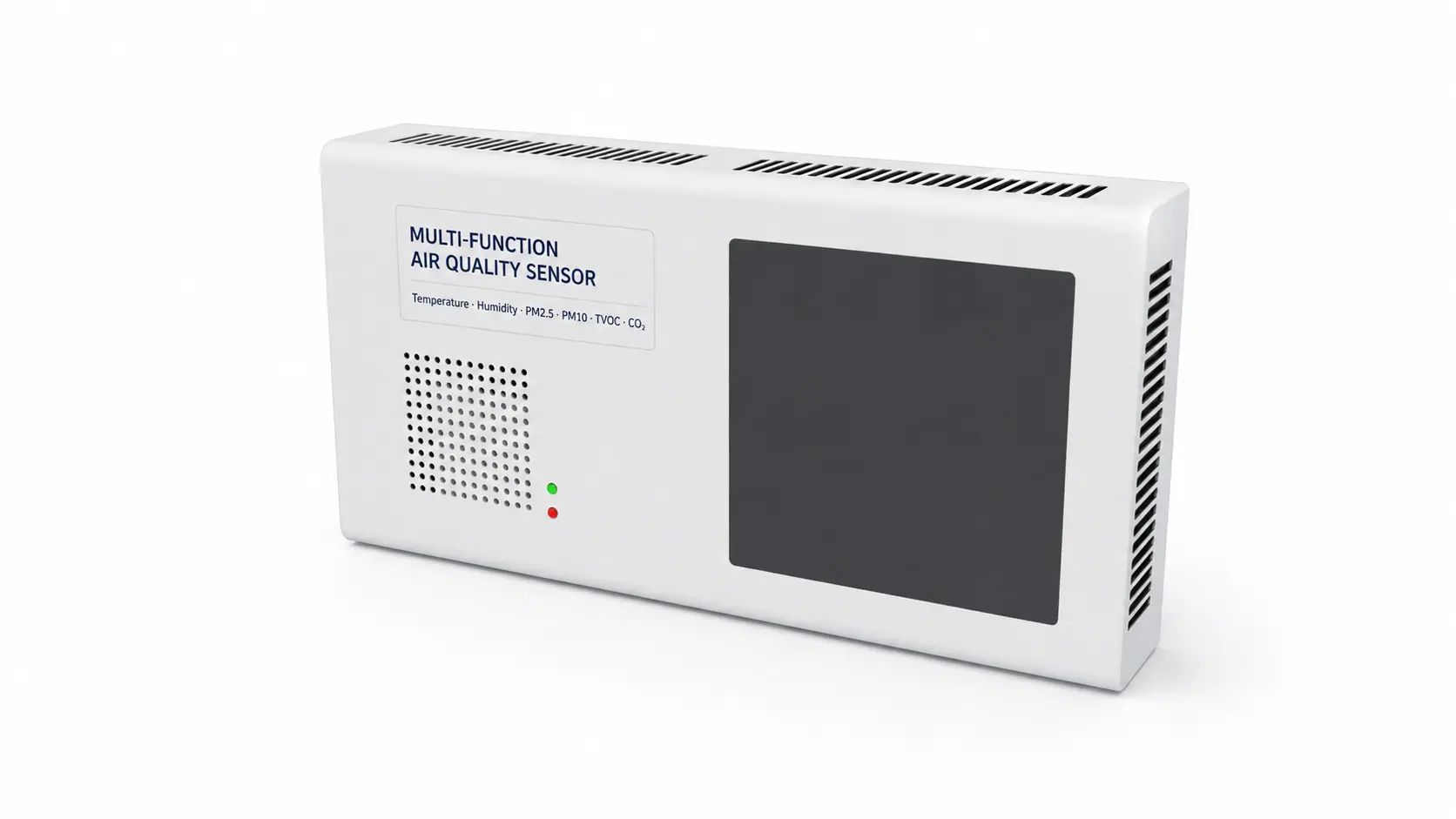
What the official catalogue confirms
The catalogue describes a wall-mounted air-quality cloud monitor with a 5.1-inch full-colour capacitive touchscreen and an eight-in-one probe.
- Displayed values refresh at a frequency of up to 2 seconds.
- Data polling can be set between 2 and 60 seconds.
- Communication options can include wireless, TCP and RS485 boards.
- Standard Modbus TCP communication supports unified archive monitoring and remote review.
- Platform users can monitor data, review records and inspect curves.
Final communication selection, mounting location and integration scope depend on the project.
Monitoring is useful when it leads to a response
A sensor is one part of the archive environmental control loop. The project should define what happens when readings change, data stops, or the room condition no longer matches the preservation plan.
- Map monitoring points to rooms, storage zones and responsible operators.
- Define review intervals for temperature, humidity, particles and gas readings.
- Set the response for missing, implausible or interrupted data.
- Coordinate monitoring with ventilation, purification, cleaning and maintenance decisions.
- Keep records and curves available for trend review and technical handover.
Coordinate the monitor with the archive room
Room and collection evidence
- room plan, storage layout and monitoring-point access;
- collection type, material sensitivity and preservation priorities;
- existing environmental history and observed air-quality concerns;
- doors, HVAC supply/return, service routes and nearby work.
System and operating evidence
- required communication method and platform connection;
- alarm recipients, data ownership and review responsibility;
- cleaning, filter and maintenance coordination;
- handover records, trend review and change-control process.
Air-quality monitoring is not a universal compliance claim
The catalogue confirms the monitor, its readings and its communication options. It does not make one universal room target, sampling layout or preservation-compliance decision valid for every archive.
Archive Air Quality Monitoring System FAQ
What does the eight-in-one monitor measure?
Temperature, humidity, PM2.5, PM10, formaldehyde, TVOC, carbon dioxide and smoke.
Can the monitor connect to a central platform?
The catalogue describes wireless, TCP and RS485 communication options, standard Modbus TCP support and remote data, record and curve review.
Does the monitor purify the archive air?
No. It measures and reports conditions. Purification, ventilation and humidity equipment are separate coordinated modules.
Where should it be installed?
Mounting points should be selected from the room plan, airflow, storage layout, collection risks and inspection access.
Make archive air quality measurable
Send the room plan, collection profile, existing monitoring and known air-quality concerns. SAS will help define a monitor and response scope grounded in the actual archive environment.
Discuss Your Archive Project